


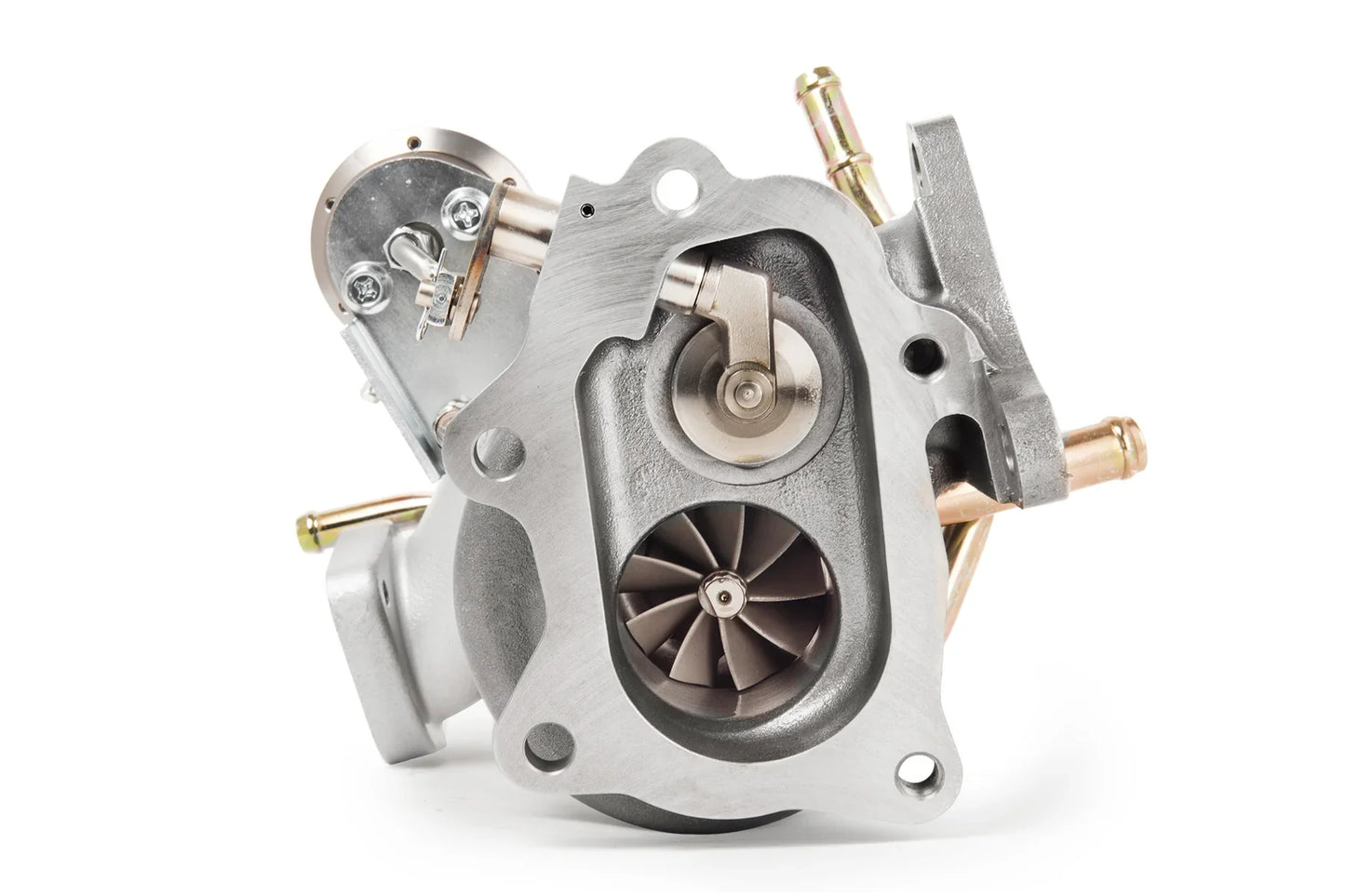
Description
We are thrilled to announce the latest breakthrough from Tomioka Racing: the TD06-20G Turbo Upgrade designed specifically for the 2008-2014 Subaru WRX. Engineered with precision and performance in mind, this turbocharger stands as the pinnacle of power enhancement for your beloved Subaru.
Unleash the full potential of your WRX with the TD06-20G, a turbocharger that pushes boundaries and redefines what's possible on the road or track. This masterpiece of engineering has been meticulously crafted to provide an unparalleled boost in performance, delivering an exhilarating driving experience like never before.
Featuring an upgraded compressor wheel and a larger turbine housing, the TD06-20G offers a significant increase in airflow and allows your engine to breathe more freely. This means more air, more fuel, and ultimately more power unleashed under your command.
Turbo Characteristics
| Bearing Type: | Dual Ceramic Ball Bearing |
|
| Flange Type: | Standard Subaru 5-Bolts | |
| Compressor Wheel | In: | 53.1 mm |
| Ex: | 71 mm | |
|
Turbine Wheel |
In: | 60 mm |
| Ex: | 55 mm | |
| Actuator: | 1.1 Bar / 16 psi (Optional 1.3 Bar / 19 psi) | |
| Turbine Housing: | 10cm2 | |
| Inlet Size: | Stock Size | |
| Max. Power: | 550 HP | |
Applications:
- 2008-2014 Subaru WRX
- 2009-2013 Subaru Forester XT SH5/9
- 2005-2009 Legacy GT
Kit Contents
- Turbocharger
- Gaskets
- Actuator
- Oil Pipe
- Water Pipe
- Hardware Kits
note: This turbo does not come with an oil pressure regulator. We recommend Turbosmart TS-0811-0012 OPR V2 Turbo Oil Pressure Regulator
Wastegate actuator spring choice: 1.1 bar vs 1.3 bar (what customers need to know)
What the spring actually controls (and why it matters)
On a pneumatic internal wastegate, the actuator spring sets your gate pressure (often called base boost): the boost level where the wastegate starts to open because boost pressure overcomes spring force. Haltech describes it simply: changing spring pressure changes the default boost pressure, and when boost exceeds spring pressure the valve opens and begins regulating boost.
Choose 1.1 bar (16.1 psi) / Red if:
You want a lower boost map (street/traction/valet) around the mid-teens. Remember: you can’t go under the spring.
Your normal target boost is roughly 18–22 psi and you want good controller authority and flexibility.
You’re building a setup where drivability and multiple boost modes matter (daily + weekend map).
Choose 1.3 bar (19.1 psi) / Silver if:
You will not run low boost—your “low boost” is still ~19 psi or higher. (If you need 15–17 psi sometimes, don’t pick this.)
Your normal target boost is roughly 22–28 psi and you want:
less “work” from the boost control system to hit target, and
typically better resistance to the wastegate being pushed open early (especially in higher load / backpressure situations).
There are two different “maximum boost” questions people ask:
1) Maximum boost your boost control can hold consistently
Using the GFB rule-of-thumb (target boost ≤ ~2× gate pressure) :
With a 1.1 bar / 16.1 psi spring, the “control stability ceiling” is roughly ~32 psi (2 × 16.1).
With a 1.3 bar / 19.1 psi spring, the “control stability ceiling” is roughly ~38 psi (2 × 19.1).
Reality check: that does not mean “safe to run 32–38 psi.” It means beyond ~2× gate pressure, boost control tends to get inconsistent because the actuator isn’t receiving enough meaningful reference signal for correction. GFB explains that once you go beyond double, boost control becomes less stable and more affected by variables like RPM/load/backpressure.
2) Maximum boost your turbo/engine can safely run
That’s not spring-limited. It’s limited by:
turbo efficiency and speed/heat,
fuel quality and knock margin,
intake temps/intercooling,
exhaust backpressure,
engine/clutch/trans limits,
tuner strategy.
FAQ:
Can I run less boost than the spring rating?
No. Spring pressure is the lowest boost level you can reach.
Does a stiffer spring automatically mean higher peak boost?
Not automatically. It mainly raises minimum boost and changes how the wastegate behaves. Boost above spring comes from the control strategy.
Why do people say “don’t exceed 2× the spring”?
Because boost control gets less stable as target boost gets too far above gate pressure; beyond ~double you tend to lose correction authority.
What spring gives the best spool and boost stability?
A spring that puts gate pressure about 10–20% under your target boost is a strong general guideline for best performance.